
NIST CSF 2.0 Gap Analysis: Turning Current and Target Profiles into a Prioritized Security Budget
Build NIST CSF 2.0 Current and Target Profiles, score each gap by impact, risk reduction and effort, and turn the results into a ranked security budget.
- Written by
- Engr Mejba Ahmed
- Published
- Reading time
- 10 min

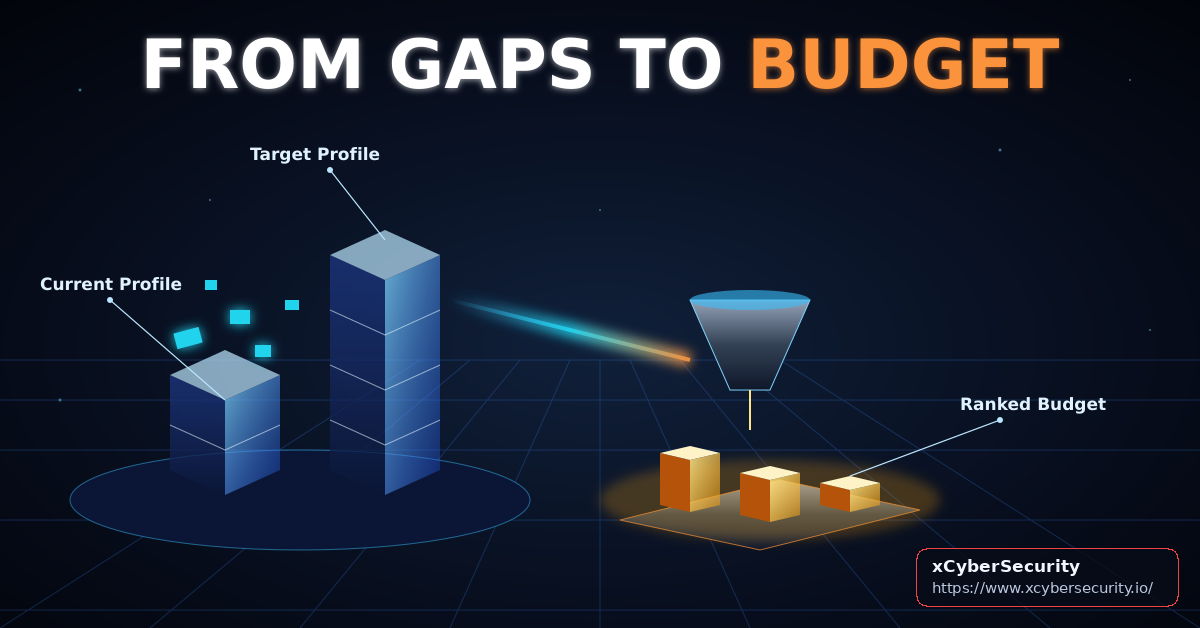
Many organizations that adopt NIST CSF 2.0 finish their first assessment with dozens of gaps and no defensible order for funding them. This guide shows you how to record a Current and Target Profile per outcome, score each gap by business impact, risk reduction and effort, and turn the result into a ranked treatment plan you can take into a budget meeting.
Why CSF Gap Lists Stall Without a Spending Order
NIST published the Cybersecurity Framework 2.0 as NIST CSWP 29 on February 26, 2024. It offers "a taxonomy of high-level cybersecurity outcomes" that any organization, regardless of size, sector or maturity, can use to "understand, assess, prioritize, and communicate its cybersecurity efforts." The same publication states that "the CSF does not prescribe how outcomes should be achieved." Instead, it links to online resources on practices and controls.
That design is deliberate, and it is also why many gap analyses stall. The framework tells you which outcomes matter. It leaves the choice of controls, the order of work and the size of each investment to you. A spreadsheet that marks 60 outcomes as "partially achieved" gives a board nothing to approve.
A gap becomes actionable once it carries four things: an impact score tied to a business process, an effort estimate, a named owner and a budget tier. Without them, every gap looks equally urgent, and the loudest stakeholder usually wins the budget.
The first tradeoff is scope. Assessing every outcome across the whole organization gives complete coverage but takes weeks and produces a list too long to act on. Scoping the first pass to one critical business process, such as online payments or customer data handling, gives you a smaller, rankable list within days. You can widen scope in later cycles. If an external audit is driving the work, align scope with the audit boundary first. For background, see Security Audits & Compliance Readiness.
What Current and Target Profiles Are (Per NIST SP 1301)
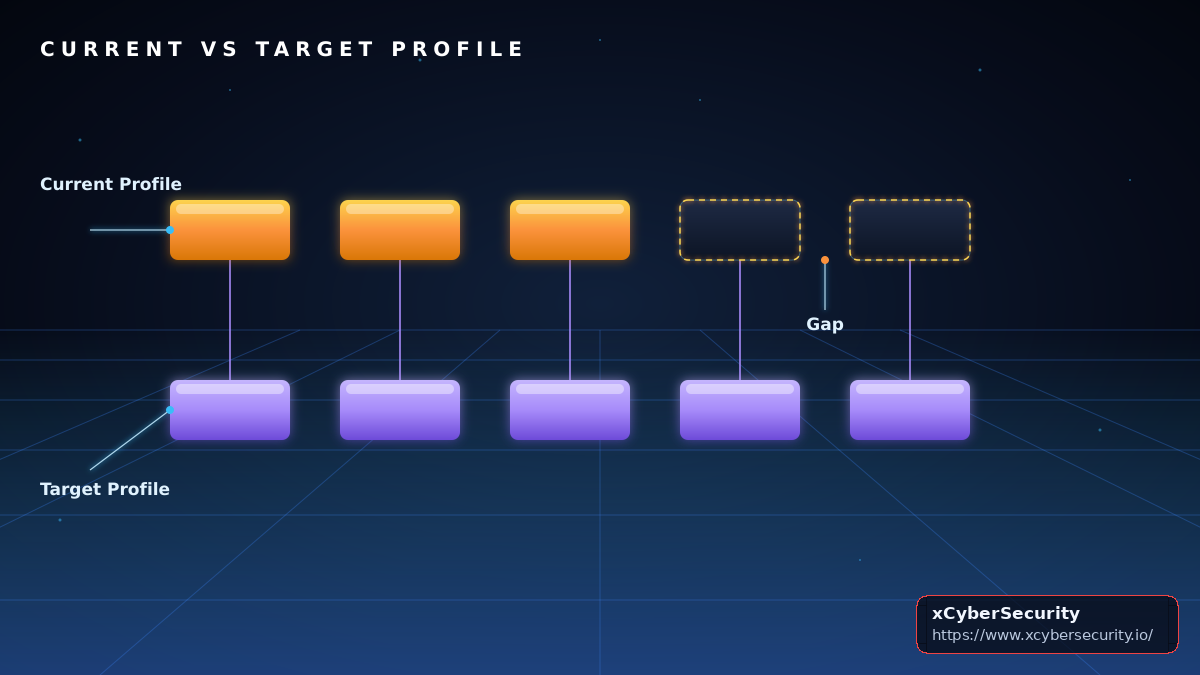
NIST defines the profile concept in NIST SP 1301, the Quick-Start Guide for Creating and Using Organizational Profiles. According to SP 1301, "an Organizational Profile describes an organization's current and/or target cybersecurity posture in terms of cybersecurity outcomes from the Cybersecurity Framework (CSF) Core." In practice, the Current Profile records where you are today and the Target Profile records where you intend to be.
SP 1301 says profiles are used to "understand, tailor, assess, and prioritize cybersecurity outcomes based on an organization's mission objectives, stakeholder expectations, threat landscape, and requirements." It adds that profiles "can also be used to assess progress toward targeted outcomes and to communicate pertinent information to stakeholders." That second use matters for budgeting: the same document that defines your gaps becomes the progress report you show leadership next quarter.
NIST also provides supporting material on its Cybersecurity Framework site:
- Profile templates and resources for creating and using CSF profiles.
- An Informative References Quick-Start Guide that explains how to find, filter and apply informative references using NIST tools.
- NIST CSWP 50, Small Business Cybersecurity: Non-Employer Firms, aimed at owner-only businesses.
If your last assessment used CSF 1.1, NIST published a spreadsheet titled "CSF 1.1 to 2.0 Core Transition Changes Overview," noted on the CSWP 29 page. Use it to translate old findings instead of discarding them.
Everything from this point on (the gap record fields, the scoring formula and the budget tiers) is an xCyberSecurity design recommendation. None of it is a NIST step, and you should adapt it to your own risk appetite.
Recording Current vs. Target State Per Outcome
Our recommendation is to keep one structured record per outcome where the Current and Target Profiles differ. A consistent record prevents two common failures: gaps that cannot be traced to a system, and gaps with no evidence behind the current-state rating.
Pull outcome identifiers and text directly from NIST's CSF 2.0 reference material rather than retyping them, so your records stay aligned with the Core. A recommended record looks like this:
# Recommended gap record (xCyberSecurity design, not a NIST format)
outcome_id: "<copy from NIST CSF 2.0 reference tool>"
outcome_text: "<copy exact outcome wording>"
current_state: partial
target_state: achieved
gap_note: "MFA enforced for admins only; staff email accounts excluded"
evidence_link: "<link to IdP policy export or screenshot>"
affected_assets: [identity-provider, email-tenant]
business_process: customer-support
owner: "IT Manager"
regulated_data: true
scores:
  impact: 4
  risk_reduction: 4
  effort: 2
Three fields do most of the work later. business_process lets you score impact in business terms rather than technical ones. regulated_data drives the priority floor described in the next section. evidence_link forces whoever rated the current state to show proof, which keeps optimistic self-assessment in check.
The main tradeoff is the rating scale. A binary achieved/not-achieved scale is fast and easy to agree on, but it hides the difference between "nothing in place" and "90% done." A graded scale (for example, not started, partial, largely achieved, achieved) gives you better resolution for effort estimates, but ratings become more subjective and workshops take longer. A practical middle path is to use three or four grades and require evidence for anything above the lowest grade.
A failure case to avoid: rating outcomes at the whole-organization level when your environments differ. If production cloud accounts are well managed but a legacy on-premises system is not, one blended rating hides the real exposure. Split the record by asset group when the gap differs materially between them.
Scoring and Ranking Gaps into Budget Tiers
The scoring method below is our own recommendation. It borrows two concepts from the NIST IR 8286 series as described on the IR 8286 Rev. 1 page: NIST IR 8286D-upd1 uses business impact analysis to inform risk prioritization by "quantifying the organizational impact and enterprise consequences of compromised IT Assets," and NIST IR 8286B-upd1 describes "applying enterprise objectives to prioritize the identified risks." We use those ideas as inspiration only; the formula and thresholds are not NIST guidance.
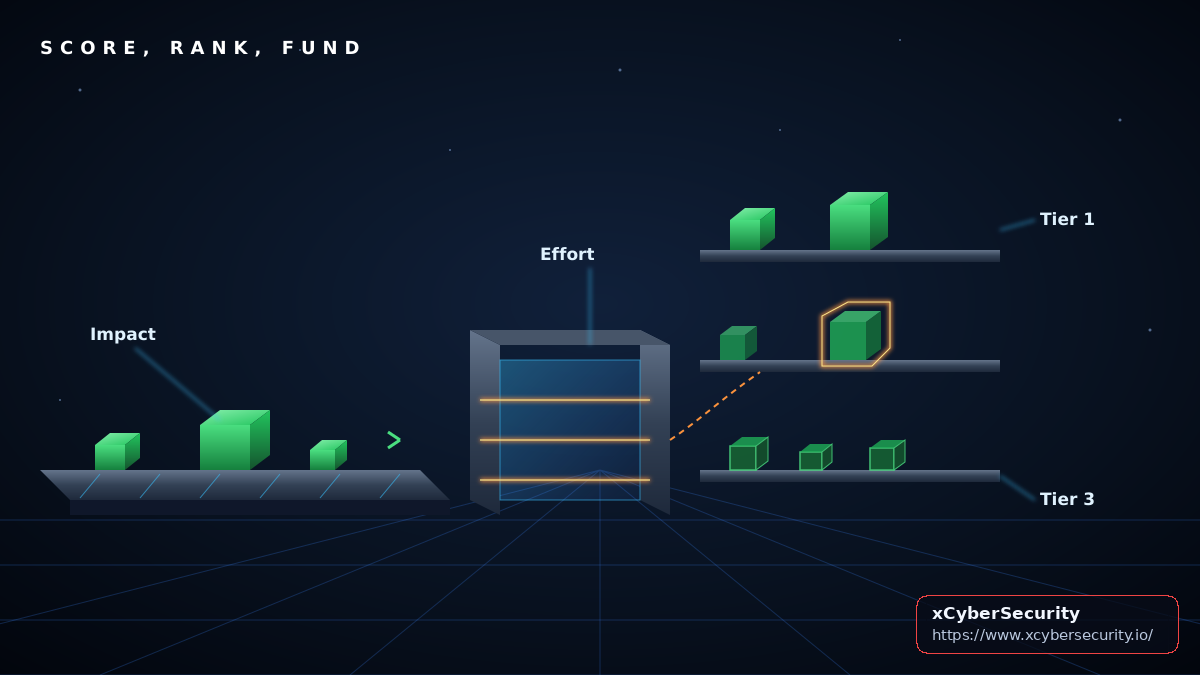
Score each gap from 1 to 5 on three dimensions:
- impact: how badly the affected business process suffers if the gap is exploited.
- risk_reduction: how much closing the gap lowers that risk.
- effort: cost, time and disruption to close it (5 is hardest).
Then compute priority = (impact * risk_reduction) / effort and assign tiers:
for gap in gaps:
    gap.priority = (gap.impact * gap.risk_reduction) / gap.effort
    if gap.priority >= 8 and gap.effort <= 2:
        gap.tier = 1   # quick win
    elif gap.priority >= 5:
        gap.tier = 2   # funded this quarter
    else:
        gap.tier = 3   # backlog
    if gap.regulated_data and gap.tier == 3:
        gap.tier = 2   # regulated-data floor

gaps.sort(key=lambda g: (g.tier, -g.priority))
Worked examples using this logic:
| Gap | Impact | Risk reduction | Effort | Priority | Tier |
|---|---|---|---|---|---|
| No offline backup of order database | 5 | 4 | 2 | 10.0 | 1 |
| MFA missing on staff email (the YAML record) | 4 | 4 | 2 | 8.0 | 1 |
| Logging gaps on web app | 3 | 4 | 2 | 6.0 | 2 |
| Legacy file server hardening, regulated data | 4 | 3 | 4 | 3.0 | 2 (floor) |
| Same server, no regulated data | 4 | 3 | 4 | 3.0 | 3 |
The third row shows that low effort alone does not make a quick win: priority must also reach 8. The last two rows show the regulated-data floor: an expensive, moderate-priority gap involving regulated data never sinks into the backlog.
The tradeoffs are real. Scores are subjective, so calibrate them in a workshop where business process owners rate impact and technical staff rate effort. Teams sometimes inflate effort to push unwanted work down the list; counter that by asking for a rough cost or person-day figure behind every effort score. Some organizations prefer to weight impact more heavily, for example by squaring it, when a single outage would be severe. Whatever weighting you choose, write it down and apply it consistently so next cycle's ranking is comparable.
Turning Ranked Gaps into CIS Safeguards and Risk Register Lines
Because CSF 2.0 links to practices without prescribing them, each ranked gap still needs a concrete control. The CIS Critical Security Controls (v8.1 is the version CIS currently presents) are described as "a prescriptive, prioritized, and simplified set of best practices," and CIS states that the Controls "consist of Safeguards that each require you to do one thing." That single-action structure makes Safeguards useful as discrete line items for Tier 1 quick wins.
Our recommendation: map each Tier 1 and Tier 2 gap to one or more Safeguards using NIST's informative references tooling or the mapping resources CIS publishes, then check each mapping yourself against the exact outcome text in your gap record. A mapping that looks right at the category level can miss the specific weakness you documented.
Next, carry each gap into your risk register so it stays visible to leadership. NIST IR 8286 Rev. 1, published December 2025 and superseding IR 8286 (10/13/2020), "includes guidance on the use of risk registers to set out cybersecurity risk" and explains the value of rolling up risk measures from system and organizational levels to the enterprise level. We recommend that each register line carry at least:
- The outcome ID and gap note from the gap record.
- Owner and treatment decision (mitigate, transfer, accept or avoid).
- Estimated cost and budget tier.
- Target date and next review date.
The tradeoff here is granularity. One register line per gap keeps traceability but can flood an enterprise register; grouping related gaps under one business process risk keeps the register readable but makes progress harder to track. A workable compromise is a grouped enterprise entry that links back to the detailed gap records.
Gaps in incident handling and recovery outcomes often need process and rehearsal work rather than tooling purchases, so budget them as staff time. For related reading, see Cybersecurity Incident Response in 2026: A Practical NIST-Based Guide.
FAQ
Is a CSF 2.0 gap analysis a certification? No. CSF 2.0 describes outcomes and does not prescribe how to achieve them, so a gap analysis is an internal planning and communication tool, not an attestation.
What is the difference between a Current and a Target Profile? Per NIST SP 1301, an Organizational Profile describes current and/or target posture in terms of CSF Core outcomes. The Current Profile records today's state; the Target Profile records the state you intend to reach.
Are we too small to use CSF? CSF 2.0 is intended for organizations of any size, and NIST CSWP 50 addresses owner-only non-employer firms specifically.
Our assessment used CSF 1.1. Do we start over? Not necessarily. Use NIST's CSF 1.1 to 2.0 Core Transition Changes Overview spreadsheet to translate existing findings.
Do we need CIS Controls? No. They are one option for turning outcomes into concrete actions; any control set you can map and verify works.
How often should we re-score? Our recommendation is every budget cycle, and after any major change such as a new cloud platform, acquisition or significant incident.
Ranking Your First CSF 2.0 Gaps Before the Next Budget Cycle
Start small and finish one full pass. This week, pick one critical business process and list the outcomes where your Current and Target Profiles differ. Complete a gap record for each, with evidence links and an owner. Then hold a single scoring workshop with the process owner and the technical lead, apply the priority formula and tier rules, and map the Tier 1 items to single-action Safeguards.
By the end of that pass you will have a short, ranked list with cost estimates and owners, plus register lines leadership can track. Repeat the cycle for the next business process, keep your scoring weights unchanged so results stay comparable, and use the updated Current Profile to show progress against the Target at each review.
Need a hand applying this to your environment? See Cybersecurity Risk Assessment by xCyberSecurity.


